


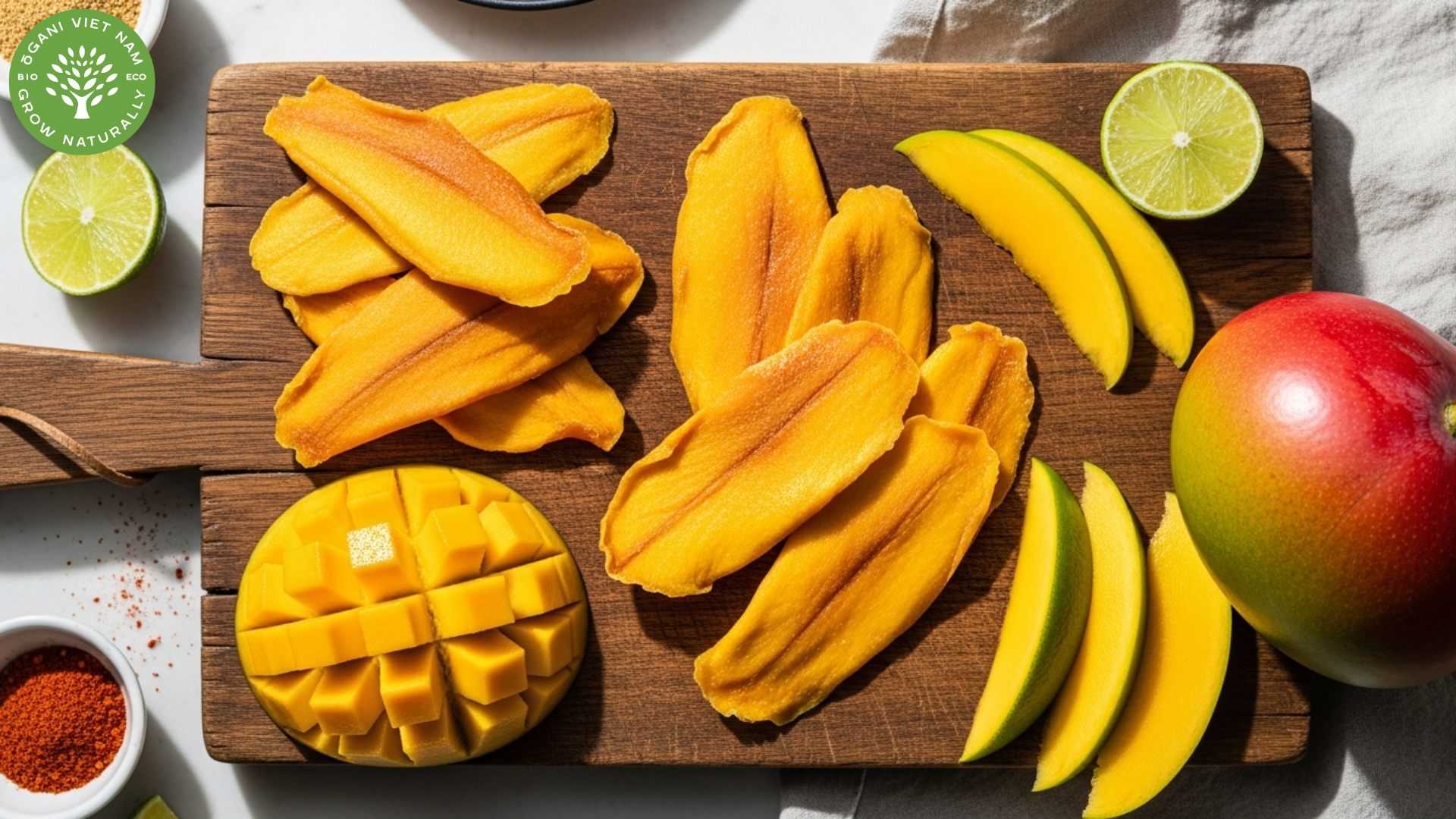
Making dried mango at home is simpler than you think. Whether you have a food dehydrator, an oven, or even just an air fryer, you can transform fresh ripe mangoes into chewy, naturally sweet snacks that rival anything you’d buy at the store. At Ogani VN, we’ve tested multiple methods to bring you foolproof techniques that work every time – no fancy equipment required.
Essential ingredients for your dried mango recipe
Before diving into the actual drying process, let’s talk about what makes or breaks a batch of homemade dried mango. The ingredient list is refreshingly short, but the quality matters more than you’d expect.
First and foremost: ripe mangoes. Not rock-hard, not mushy-overripe, but that perfect sweet spot where the flesh gives slightly when you press it and the aroma hits you the moment you slice into it. We typically use 3-4 medium mangoes per batch, which yields about 1-2 cups of dried fruit depending on how thick you slice them. Varieties like Ataulfo, Kent, or Tommy Atkins work beautifully – each brings its own sugar content and texture to the final product.
For equipment, you have options. A food dehydrator makes the process almost hands-off, maintaining consistent temperature for 8-12 hours. Don’t have one? Your regular oven works just fine, though you’ll need a wire cooling rack to allow air circulation. Some folks swear by air fryers for smaller batches – they’re faster but require more attention. Beyond that, you need a sharp knife, a cutting board, and optionally some parchment paper if your equipment requires it.
Here’s something we’ve learned through trial and error: organic mangoes tend to dry more evenly. The texture stays consistent throughout the slice, whereas conventionally-grown fruit sometimes develops hard spots. Not a dealbreaker, just an observation from our test kitchen.
Step-by-step dried mango recipe (3 methods)
The beauty of making dried mango recipe variations lies in their flexibility. You’re essentially removing moisture while concentrating those tropical flavors, and there are several paths to get there.
Making dried mango in a dehydrator

This method is our personal favorite at Ogani VN – set it and forget it. Start by peeling your mangoes and slicing them into uniform pieces about ¼ inch thick (roughly 5-6mm). Thinner slices dry faster but can become brittle; thicker ones stay chewier but take longer. Arrange the mango slices on your dehydrator trays without overlapping – air needs to circulate freely around each piece.
Set your dehydrator to 135°F (57°C). Some recipes suggest going as low as 125°F for a longer, gentler dry, while others push to 145°F for speed. We find 135°F hits the sweet spot – literally. The drying time ranges from 8 to 12 hours depending on slice thickness and your mango’s moisture content. You’ll know they’re done when the slices feel pliable and slightly tacky but no longer wet. They shouldn’t snap when bent, but they shouldn’t feel squishy either.
Pro tip from our experience: rotate your trays every 3-4 hours if your dehydrator doesn’t have a fan that distributes heat evenly. Bottom trays often finish faster than top ones.
Using your oven to dry mango

No dehydrator? No problem. Preheat your oven to 175°F (80°C) – if your oven doesn’t go that low, set it to the lowest temperature and prop the door open slightly with a wooden spoon. This prevents overheating and allows moisture to escape.
Place your mango slices on a wire cooling rack set over a baking sheet. The rack is crucial here; laying slices directly on a baking sheet traps moisture underneath, leading to uneven drying and potentially sticky bottoms. Slide everything into the oven and plan for about 5-6 hours of drying time.
Here’s where it gets hands-on: flip each slice every hour. Yes, every single hour. It’s tedious, but this ensures even drying on both sides and prevents the slices from sticking to the rack. We usually set a timer and treat it as an excuse to stretch our legs throughout the afternoon.
The oven method tends to produce slightly different results than a dehydrator – sometimes the edges dry faster, creating a chewier center with crisper borders. Some people love this variation in texture; others prefer the uniformity of dehydrator-dried fruit.
Air fryer method for quick batches
This is the speed demon of dried mango methods, though it only works for small quantities. Preheat your air fryer to 135°F if it has a dehydrate setting, or the lowest temperature available. Arrange mango slices in a single layer in the basket – don’t crowd them.
The drying process takes 4-6 hours, and you’ll need to check and flip the slices every 45 minutes to an hour. Air fryers can create hot spots, so rotating the slices prevents burning while ensuring even dehydration. This method works brilliantly when you want fresh dried mango quickly or you’re testing flavor variations before committing to a larger batch.
One thing we’ve noticed: air-fried dried mango sometimes develops slightly caramelized edges due to the concentrated heat. Not a bad thing at all – it actually intensifies the sweetness and creates interesting flavor notes.
Creative dried mango recipe variations
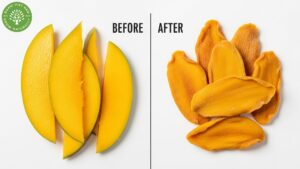
Plain dried mango is incredible on its own, but sometimes you want to push the boundaries. These dried mango recipe variations have become staples in our rotation at Ogani VN.
The chile lime version might be the most addictive thing we’ve ever made. Once your mango slices are about 80% dry (still slightly pliable but mostly dehydrated), lightly brush them with fresh lime juice and sprinkle with a mixture of chili powder and a tiny pinch of sea salt. Return them to the dehydrator or oven for the final hour. The result? A sweet-spicy-tangy explosion that disappears frighteningly fast from our snack stash.
For a tropical twist, dust your dried mango slices with finely shredded coconut during the last 30 minutes of drying. The coconut toasts slightly and adheres to the tacky surface, creating a texture contrast that’s genuinely delightful. We’ve also experimented with cinnamon sugar (classic but effective), tajín seasoning (if you can find it), and even a light drizzle of honey in the final stages for extra glossy, candy-like pieces.
Here’s a variation that surprised us: savory dried mango. Sprinkle very thin slices with black pepper and smoked paprika before drying. It sounds odd, but the result works beautifully in salads or as a garnish for grain bowls. The natural fruit sugars balance the savory spices in a way that keeps you reaching for another piece.
How to store your homemade dried mango recipe

Making dried mango is only half the battle – proper storage ensures you can enjoy your homemade treats for weeks or even months. Let the dried mango slices cool completely to room temperature before packing them away. This step is non-negotiable; any residual warmth creates condensation in your storage container, which invites mold.
Store your dried fruit in an airtight container or resealable plastic bag. We prefer glass jars with tight-fitting lids – they’re reusable and you can see your beautiful work. Keep the containers in a cool, dark place like a pantry shelf. Properly dried and stored mango lasts about 2-3 weeks at room temperature. Want to extend that? Refrigerate them for up to 2 months, or freeze for up to 6 months.
Here’s a trick from our kitchen: if you notice any condensation forming inside your storage container within the first few days, your mango wasn’t quite dry enough. Don’t panic – just return the slices to your dehydrator or oven for another hour or two. Better safe than sorry when it comes to food preservation.
Some people add silica gel packets to their storage containers for extra moisture protection, especially in humid climates. It’s not essential, but it does provide an extra layer of insurance if you’re planning to keep your dried mango for extended periods.
Frequently asked questions about dried mango recipe
How long does homemade dried mango last? When stored properly in an airtight container at room temperature, homemade dried mango lasts 2-3 weeks. Refrigeration extends this to 2 months, while freezing can preserve your dried fruit for up to 6 months without significant quality loss.
Can I make dried mango without a dehydrator? Absolutely! Your regular oven works perfectly for making dried mango recipe at home. Set it to the lowest temperature (around 175°F), use a wire rack for air circulation, and flip the slices hourly. The process takes about 5-6 hours.
What’s the best mango variety for drying? Ataulfo, Kent, and Tommy Atkins mangoes work exceptionally well for drying. Look for ripe but firm mangoes with high sugar content – they’ll give you the best flavor and texture once dehydrated.
How thick should I slice mangoes for drying? Aim for ¼ inch (about 5-6mm) thickness. Thinner slices dry faster but become more brittle, while thicker slices stay chewier but require longer drying time. Uniform thickness ensures even drying across all pieces.
Why is my dried mango sticky? Stickiness usually means the mango wasn’t dried long enough. Properly dried mango should feel pliable and slightly tacky but not wet. If yours is too sticky, return it to the dehydrator or oven for another 1-2 hours.
Start making your dried mango recipe today
There’s something deeply satisfying about making your own dried mango – watching fresh fruit transform into concentrated bites of tropical sweetness, knowing exactly what went into them (just mango, nothing else), and having control over the texture and flavor variations. At Ogani VN, we believe everyone should experience this simple pleasure at least once.
The best part? You don’t need expensive equipment or specialized skills. Whether you’re using a dehydrator, your everyday oven, or even an air fryer, the process remains straightforward and forgiving. Start with a small batch to get the hang of it. Try the basic dried mango recipe first, then experiment with chile lime or coconut variations once you’ve mastered the fundamentals.
Ready to stock your pantry with homemade goodness? Grab some ripe mangoes and dedicate a lazy afternoon to this rewarding project. Your future self will thank you when you’re reaching for these healthy, preservative-free snacks instead of store-bought alternatives. And if you’re looking for high-quality organic dried fruits and superfoods to complement your homemade creations, explore our collection at Ogani VN – we’re here to support your journey toward healthier, more mindful snacking.
Read more:
- Baking With Dried Red Dragon Fruit: Breads, Muffins & Cookies
- Dried Red Dragon Fruit vs Fresh: Color, Nutrition & When to Use Each
- Dragon Fruit Powder: Unlocking Ít Superfood Potential for Health and Wellness.
- Dehydrated Mango – Healthy Snack From Fresh Mangoes
- Dried Mango Recipe: Easy Homemade Guide (3 Methods)